Tej Pratap asks singer to not sing ‘vulgar’ songs at Patna event
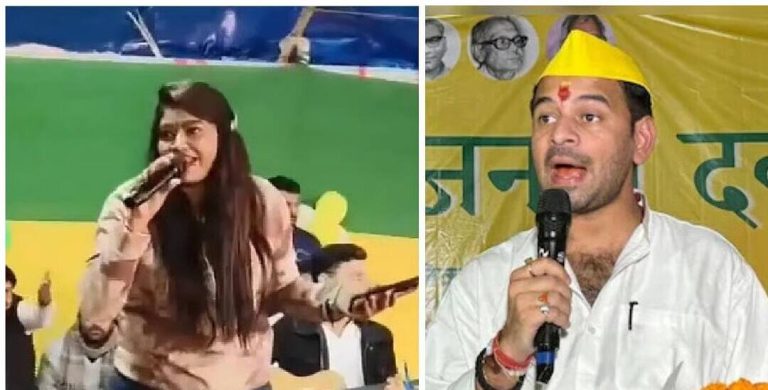
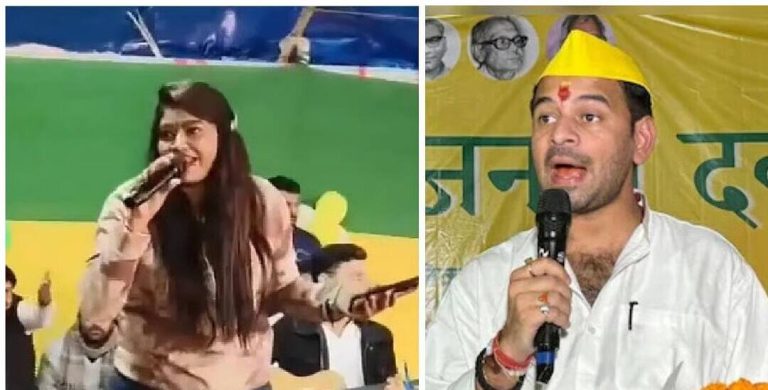
In a bizarre incident, Janata Jalajhari Dal (JJD) chief Tej Pratap Yadav was seen interrupting a Bhojpuri singer’s performance at a Makar Sankranti event in Patna. A video of the incident has gone viral on social media, where Yadav can be heard telling the singer to stop singing “vulgar” songs and instead sing devotional songs. The video has sparked a debate on social media, with many users praising Yadav’s move, while others have criticized him for interfering with the singer’s performance.
According to reports, the incident took place at a Makar Sankranti event in Patna, where the Bhojpuri singer was performing on stage. Yadav, who was present at the event, suddenly got up from his seat and walked onto the stage, interrupting the singer’s performance. He then told the singer to stop singing “vulgar” songs and instead sing devotional songs. “Krishna ji wala bhajan gaao (sing hymns of Lord Krishna),” he added.
The singer, who seemed taken aback by Yadav’s sudden interruption, tried to reason with him, but Yadav was firm in his request. He told the singer that she should sing songs that promote good values and culture, rather than singing “vulgar” songs that may corrupt the minds of the youth. The singer eventually agreed to Yadav’s request and started singing devotional songs, which were well-received by the audience.
The video of the incident has gone viral on social media, with many users praising Yadav for taking a stand against “vulgar” songs. Some users have even hailed him as a “cultural guardian” who is trying to promote good values and culture in society. However, others have criticized him for interfering with the singer’s performance and trying to impose his own values on others.
While some have argued that Yadav’s move was justified, as he was trying to promote good values and culture, others have argued that he was wrong to interrupt the singer’s performance and dictate what she should sing. They have pointed out that the singer was performing at a public event and had the right to choose her own songs, and that Yadav should not have interfered with her performance.
The incident has also sparked a debate on the role of politicians in promoting culture and values in society. While some have argued that politicians have a responsibility to promote good values and culture, others have argued that they should not try to impose their own values on others. They have pointed out that politicians should respect the rights of artists and musicians to create and perform their own work, without interference or censorship.
In recent years, there have been several incidents of politicians and activists trying to censor or ban certain types of music or art, on the grounds that they are “vulgar” or “obscene”. However, such moves have been widely criticized by artists and musicians, who argue that they have the right to freedom of expression and creativity.
The incident involving Tej Pratap Yadav and the Bhojpuri singer is just the latest example of this trend. While Yadav may have had good intentions in trying to promote good values and culture, his actions have been widely criticized as an example of censorship and interference with artistic freedom.
In conclusion, the incident involving Tej Pratap Yadav and the Bhojpuri singer has sparked a debate on social media, with many users praising Yadav’s move, while others have criticized him for interfering with the singer’s performance. While the incident may have been well-intentioned, it highlights the need for politicians to respect the rights of artists and musicians to create and perform their own work, without interference or censorship.
As the debate continues, it is clear that the issue of censorship and artistic freedom is complex and multifaceted. While there may be a need to promote good values and culture in society, this should not be done at the expense of artistic freedom and creativity. Instead, politicians and activists should work to promote a culture of tolerance and respect for diversity, where artists and musicians are free to create and perform their own work, without fear of censorship or interference.
About the Author