Sky turns pink in UK’s Birmingham as snow reflects stadium lights
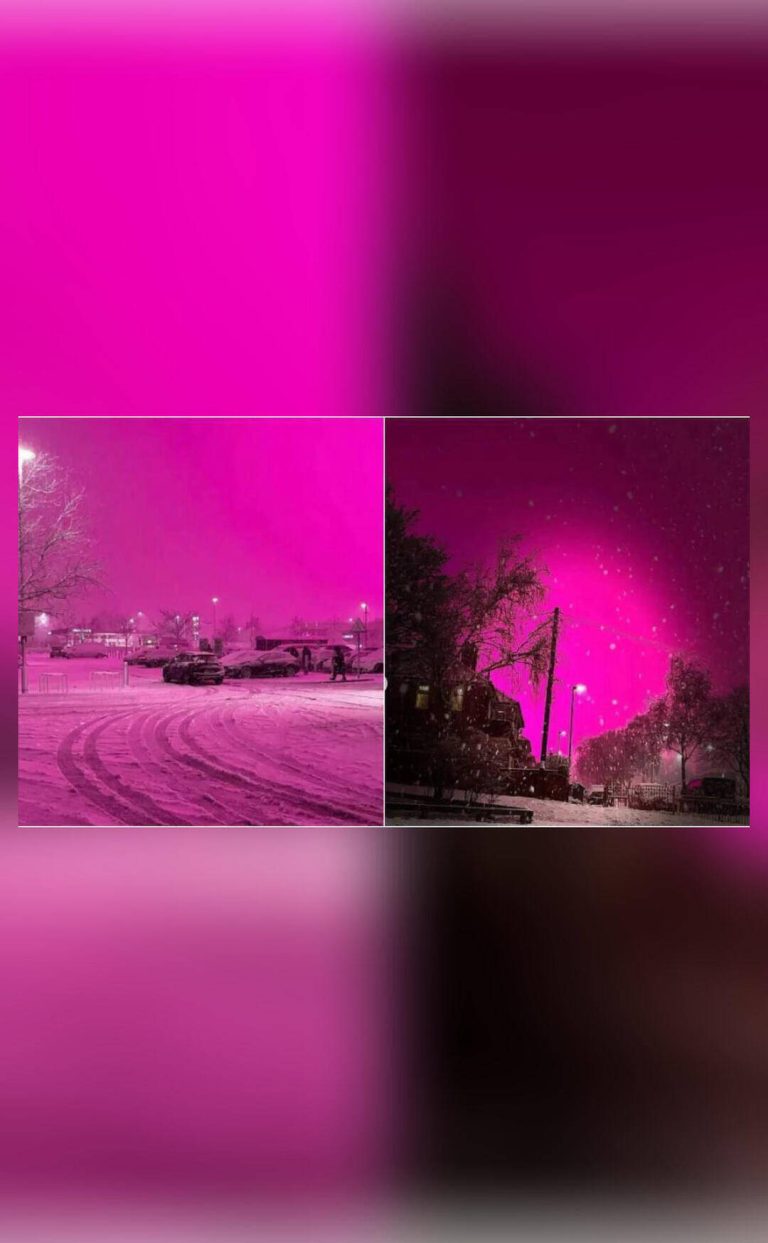
The city of Birmingham in the United Kingdom witnessed a breathtaking sight on Thursday evening as the sky turned a mesmerizing shade of pink. The unusual phenomenon sent shockwaves of wonder among the residents and visitors alike, with many taking to social media to share their experiences and photos of the pink sky. However, as it often turns out, the truth behind this spectacle was not as extraordinary as it seemed. The pink colour of the sky was not due to a natural phenomenon, but rather a result of the floodlights at St Andrew’s Stadium.
For those who may not be familiar, St Andrew’s Stadium is a football stadium located in Birmingham, and it is the home of Birmingham City Football Club. The stadium is equipped with state-of-the-art LED floodlights that provide excellent illumination for night matches and events. On Thursday evening, these LED lights, combined with the low cloud cover and snow, created a unique combination that made the sky appear pink.
The science behind this phenomenon is quite fascinating. When the LED lights at the stadium were turned on, they emitted a broad spectrum of light that included all the colours of the visible spectrum. However, the low cloud cover and snow in the area acted as a reflector, scattering the shorter wavelengths of light, such as blue and violet, more than the longer wavelengths, like red and orange. This phenomenon is known as Rayleigh scattering, named after the British physicist Lord Rayleigh, who first described it in the late 19th century.
As a result of this scattering, the light that was reflected back to the observers on the ground had a higher proportion of longer wavelengths, which we perceive as pink or reddish in colour. The snow on the ground and the clouds in the sky acted as a giant reflector, amplifying the effect and making the sky appear pink. It was as if the entire city was bathed in a warm, rosy glow, creating a truly magical atmosphere.
The phenomenon was not limited to the immediate vicinity of the stadium. People from all over the city reported seeing the pink sky, with some even sharing photos and videos on social media. The sight was so breathtaking that it quickly went viral, with many news outlets and websites picking up the story.
While the sight of a pink sky may seem like a rare and extraordinary event, it is not entirely unprecedented. Similar phenomena have been observed in other parts of the world, often in association with dust, smoke, or water droplets in the air. However, the combination of factors that came together to create the pink sky in Birmingham was unique, making it a special treat for the residents and visitors of the city.
As the news of the pink sky spread, many people took to social media to share their thoughts and reactions. Some were amazed by the beauty of the sight, while others were curious about the science behind it. A few even joked about the possibility of the sky turning pink being a sign of something more extraordinary, such as a UFO sighting or a supernatural event.
In conclusion, the sky turning pink in Birmingham was a remarkable sight that was made possible by the combination of the LED lights at St Andrew’s Stadium, low cloud cover, and snow. While it may not have been a natural phenomenon in the classical sense, it was still a breathtaking sight that brought joy and wonder to the people of Birmingham. As we continue to explore and understand the world around us, it is essential to appreciate the beauty and complexity of the natural world, as well as the ways in which human-made structures and technologies can interact with it to create unique and fascinating phenomena.
About the Author