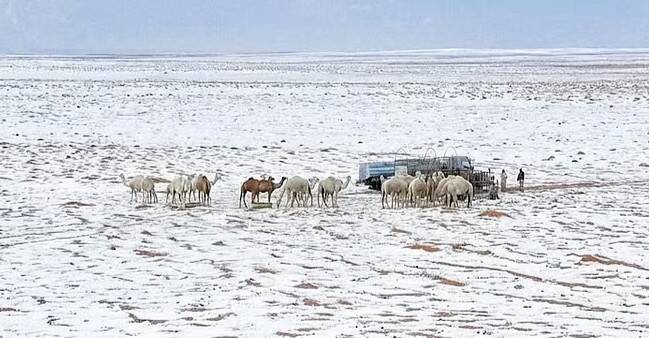
Saudi Deserts Once Had Rivers, Lakes and Grasslands: Study
The deserts of Saudi Arabia are known for their harsh and arid conditions, with endless dunes of sand stretching as far as the eye can see. However, new research has revealed that these deserts were not always the barren landscapes we see today. In fact, they were once teeming with life, featuring rivers, lakes, and vast grasslands that supported a wide range of plants, animals, and even early human populations.
The study, which has shed new light on the region’s past, has shown that the Saudi deserts have undergone significant transformations over the centuries, with periods of wetter and drier climates shaping the landscape. One of the most striking discoveries is that the Rub’ al-Khali, also known as the Empty Quarter, was once a huge lake. This vast desert, which covers much of southern Saudi Arabia, is now an ocean of sand, with dunes reaching as high as 250 meters. However, during wetter climatic phases, it was a thriving ecosystem, with hippos, crocodiles, and other water-dependent species calling it home.
The research has also revealed that the region’s rivers and lakes supported a wide range of aquatic life, including fish, turtles, and other species that are now found only in more temperate regions. The presence of these species suggests that the climate in Saudi Arabia was once much more hospitable, with ample rainfall and vegetation to support a diverse range of flora and fauna.
The study’s findings are based on a range of evidence, including fossil records, sediment cores, and archaeological remains. By analyzing these different lines of evidence, researchers have been able to reconstruct the region’s environmental history, painting a picture of a landscape that was once very different from the one we see today.
One of the key factors that has contributed to the transformation of the Saudi deserts is climate change. Over the centuries, the region has experienced significant shifts in temperature and precipitation patterns, with periods of drought and aridity alternating with periods of wetter and more temperate conditions. These changes have had a profound impact on the landscape, with the expansion and contraction of deserts, rivers, and lakes shaping the environment in profound ways.
The discovery of a lush and verdant past in Saudi Arabia has significant implications for our understanding of the region’s history and ecology. It suggests that the deserts of Saudi Arabia are not just barren and lifeless landscapes, but are instead dynamic and evolving ecosystems that have supported a wide range of plant and animal life over the centuries.
The study’s findings also have important implications for conservation and environmental management in the region. By understanding the historical context of the Saudi deserts, researchers and policymakers can develop more effective strategies for managing these ecosystems, including the conservation of threatened and endangered species, and the protection of fragile and unique habitats.
In addition to its scientific significance, the study’s findings also have cultural and historical importance. The discovery of a lush and verdant past in Saudi Arabia challenges traditional narratives about the region’s history and ecology, and highlights the importance of interdisciplinary research and collaboration in understanding the complex and evolving relationships between humans and the environment.
In conclusion, the deserts of Saudi Arabia are not just harsh and arid landscapes, but are instead complex and dynamic ecosystems with a rich and varied history. The discovery of rivers, lakes, and grasslands in these deserts is a reminder of the profound impact of climate change on the environment, and highlights the importance of continued research and conservation efforts to protect these unique and fragile ecosystems.
The study’s findings are a testament to the power of scientific inquiry and the importance of continued exploration and discovery. By shedding new light on the region’s past, researchers have opened up new avenues for understanding the complex relationships between humans and the environment, and have highlighted the need for continued conservation and environmental management efforts to protect these unique and fragile ecosystems.
About the Author