Khawaja Asif’s ‘Pak won’t need IMF in 6 months’ claim runs into a $10.6-bn wall: Report
In a recent statement, Pakistan’s Defence Minister Khawaja Asif made a bold claim that the country would no longer require financial assistance from the International Monetary Fund (IMF) within the next six months. This assertion was met with a mix of surprise and skepticism, given Pakistan’s precarious economic situation. However, as it turns out, Asif’s claim may have hit a significant roadblock, courtesy of a whopping $10.6 billion debt owed to the IMF alone.
According to a report by Moneycontrol, Pakistan’s economic woes are far from over, despite the country’s recent success in converting its Operation Sindoor-linked propaganda into defense deals worth billions. While these deals are undoubtedly a significant achievement, they are unlikely to single-handedly save Pakistan from the brink of economic collapse. The primary reason for this is the massive debt that Pakistan has accrued, particularly with regards to the IMF.
The $10.6 billion debt owed to the IMF is a substantial burden, one that Pakistan will struggle to pay off in the near future. This amount is part of a larger loan package that the IMF had extended to Pakistan to help the country stabilize its economy. However, with the loan’s conditions and repayment schedule, it is becoming increasingly clear that Pakistan’s economic troubles are far from over.
Khawaja Asif’s claim that Pakistan won’t need IMF assistance in six months seems overly optimistic, if not downright unrealistic, given the country’s current economic situation. The $10.6 billion debt is just one aspect of Pakistan’s broader economic challenges, which include a struggling currency, soaring inflation, and a significant trade deficit. These issues will not be resolved overnight, and it is unlikely that Pakistan will be able to wean itself off IMF support in such a short timeframe.
Furthermore, the IMF’s loan conditions are designed to ensure that Pakistan implements necessary economic reforms to stabilize its economy and prevent future crises. These conditions often include measures such as increasing taxes, reducing subsidies, and implementing austerity measures, which can be painful for the general population. Given Pakistan’s history of struggling to implement such reforms, it is unlikely that the country will be able to meet the IMF’s conditions and repay its debt in the near future.
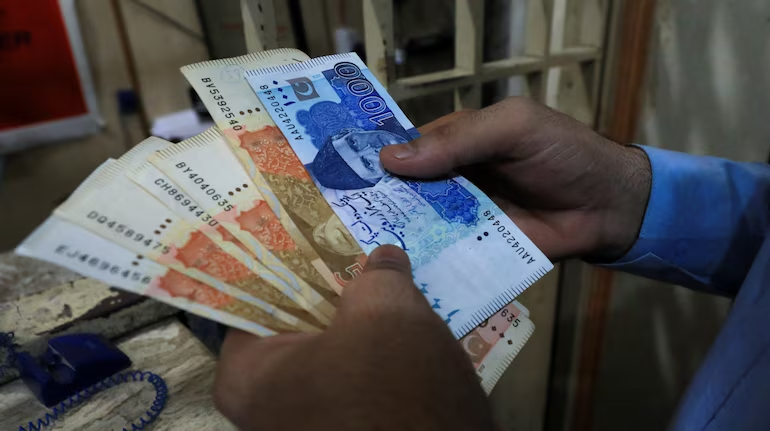
In addition to the $10.6 billion debt owed to the IMF, Pakistan also faces other significant economic challenges. The country’s foreign exchange reserves are dwindling, and its trade deficit is widening. The Pakistani rupee has also been under significant pressure, having depreciated substantially against the US dollar in recent months. These factors, combined with the country’s high inflation rate and struggling economy, make it unlikely that Pakistan will be able to recover without continued IMF support.
It is worth noting that Pakistan has a history of relying on IMF bailouts to stabilize its economy. The country has received numerous IMF loans over the years, each with its own set of conditions and repayment schedules. While these loans have provided temporary relief, they have not addressed the underlying structural issues that plague Pakistan’s economy. Until the country is able to implement meaningful economic reforms and address its underlying challenges, it is unlikely to break free from the cycle of IMF bailouts.
In conclusion, Khawaja Asif’s claim that Pakistan won’t need IMF assistance in six months seems to be nothing more than a pipe dream, given the country’s significant economic challenges. The $10.6 billion debt owed to the IMF is just one aspect of Pakistan’s broader economic woes, which will not be resolved overnight. While the country’s recent defense deals are a positive development, they are unlikely to single-handedly save Pakistan from economic ruin. Until the country is able to implement meaningful economic reforms and address its underlying challenges, it will likely continue to rely on IMF support.
About the Author