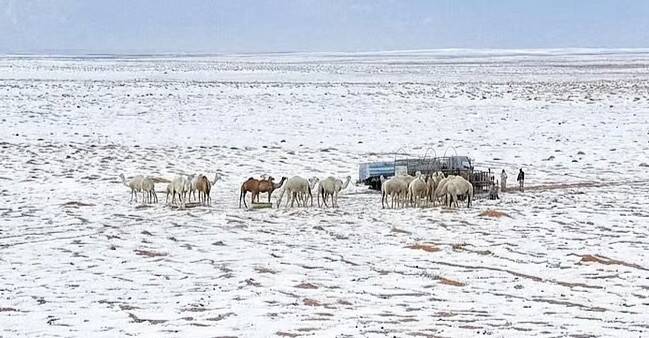
Saudi Deserts Once Had Rivers, Lakes, and Grasslands: Study
The deserts of Saudi Arabia are known for their harsh and arid conditions, with endless dunes of sand stretching as far as the eye can see. However, new studies have revealed that this was not always the case. In a fascinating discovery, scientists have found that the deserts of Saudi Arabia were once rich and diverse landscapes, complete with rivers, lakes, and vast grasslands that supported a wide range of plants, animals, and even early humans.
The study, which was conducted by a team of researchers from around the world, used a combination of geological and archaeological evidence to reconstruct the environmental history of the region. By analyzing sediment cores, fossil records, and other data, the team was able to paint a picture of a Saudi Arabia that was very different from the desert landscape we see today.
One of the most significant findings of the study was the discovery that the Rub’ al-Khali, a vast desert region in southern Saudi Arabia, was once a huge lake. The lake, which was likely formed during a period of heavy rainfall, would have been a vital source of water and sustenance for the plants and animals that lived in the area. The presence of the lake would also have supported a wide range of aquatic life, including hippos, crocodiles, and other water-dependent species.
In addition to the lake, the study found that the deserts of Saudi Arabia were also home to vast grasslands, which would have supported a wide range of herbivores, such as gazelles, antelopes, and other ungulates. These grasslands would have been an important source of food and shelter for the early humans who lived in the region, and would have played a key role in the development of human societies in the area.
The study also found that the climate of Saudi Arabia has undergone significant changes over the past few thousand years. During wetter climatic phases, the region would have experienced heavy rainfall, which would have filled the lakes and rivers, and supported the growth of lush vegetation. However, when the climate shifted and the rainfall decreased, the waters would have vanished, and the sands would have reclaimed the land.
This process of climatic change and environmental transformation would have had a significant impact on the plants and animals that lived in the region. Many species that were adapted to the wetter conditions would have been forced to migrate or adapt to the new, drier conditions. Others would have gone extinct, unable to survive in the harsh new environment.
The discovery that Saudi Arabia’s deserts were once rich and diverse landscapes has significant implications for our understanding of the region’s environmental history. It highlights the importance of considering the long-term perspective when trying to understand the complex relationships between the environment, climate, and human societies.
It also underscores the importance of preserving and protecting the natural environments that still exist in the region. While the deserts of Saudi Arabia may seem harsh and inhospitable, they are still home to a wide range of unique and adapted species, many of which are found nowhere else on Earth.
In conclusion, the study of Saudi Arabia’s environmental history is a fascinating and complex topic, which highlights the significant changes that have occurred in the region over the past few thousand years. From the presence of huge lakes and vast grasslands, to the diversity of plants and animals that once thrived in the area, the deserts of Saudi Arabia have a rich and varied past. As we continue to learn more about this fascinating region, we are reminded of the importance of preserving and protecting the natural environments that still exist, and of considering the long-term perspective when trying to understand the complex relationships between the environment, climate, and human societies.
About the Author