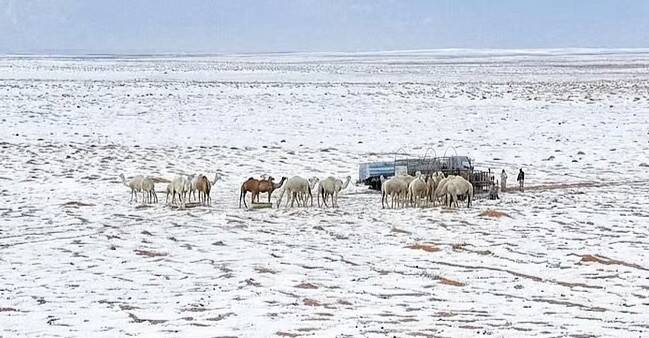
Saudi Deserts Once Had Rivers, Lakes, and Grasslands: Study
The deserts of Saudi Arabia, known for their vast expanses of sand and arid landscapes, have a secret: they were not always so barren. New studies have revealed that these deserts were once rich and diverse landscapes, teeming with rivers, lakes, and vast grasslands that supported a wide range of plants, animals, and even early humans. The discovery has shed new light on the region’s history and has significant implications for our understanding of climate change and its impact on the environment.
The Rub’ al-Khali, also known as the Empty Quarter, is one of the largest sand deserts in the world, covering over 650,000 square kilometers in southern Saudi Arabia. Today, it is an ocean of sand, with towering dunes that stretch as far as the eye can see. However, scientists have found that this vast expanse of sand was once a huge lake, filled with water and home to a wide range of aquatic life.
The evidence for this ancient lake comes from a variety of sources, including fossil records, sediment cores, and remote sensing data. Researchers have found fossils of fish, crocodiles, and other water-dependent species in the region, which suggests that the area was once much wetter than it is today. Sediment cores have also revealed layers of lake sediment, including mud, silt, and clay, which are characteristic of lake environments.
But how did this lake form, and what happened to it? Scientists believe that the lake was created during a period of increased rainfall in the region, which occurred during the African Humid Period (AHP). This period, which lasted from around 11,000 to 4,000 years ago, was characterized by increased rainfall and flooding in many parts of Africa and the Middle East. The increased rainfall filled the lake, creating a vast body of water that supported a wide range of aquatic life.
However, when the climate shifted and the rainfall decreased, the lake began to dry up. The waters vanished, and the sands reclaimed the land, creating the vast expanse of sand that we see today. This process was likely accelerated by changes in the Earth’s orbit, which reduced the amount of solar radiation that the region received.
The discovery of this ancient lake has significant implications for our understanding of the region’s history and the impact of climate change on the environment. It suggests that the deserts of Saudi Arabia are not static environments, but rather dynamic systems that have changed over time in response to changes in the climate.
But the Rub’ al-Khali was not the only region in Saudi Arabia that was once more verdant. Other parts of the country, including the Nafud Desert in the north, were also home to rivers, lakes, and grasslands. Fossil records have revealed that hippos, crocodiles, and other water-dependent species once thrived in these regions, which suggests that they were once much wetter than they are today.
The presence of these species in Saudi Arabia is significant, as it suggests that the region was once connected to other parts of Africa and the Middle East by a network of rivers and lakes. This network, which has been dubbed the “Green Sahara,” would have allowed species to migrate and disperse across the region, creating a rich and diverse ecosystem.
The discovery of this ancient ecosystem has significant implications for our understanding of human history and the development of civilizations in the region. It suggests that early humans would have been able to migrate and settle in the region, taking advantage of the abundant resources and favorable climate.
In fact, archaeological evidence has revealed that early humans did indeed settle in the region, taking advantage of the abundant resources and favorable climate. The discovery of stone tools, fossils, and other artifacts has revealed that humans were present in the region at least 10,000 years ago, and possibly much earlier.
The study of these ancient ecosystems has also shed new light on the impact of climate change on human societies. The shift from a wet to a dry climate would have had significant implications for the people living in the region, who would have had to adapt to a new and challenging environment. The loss of water sources, the decline of agriculture, and the shift to a more nomadic lifestyle would have all had significant social, economic, and cultural implications.
In conclusion, the deserts of Saudi Arabia are not just barren expanses of sand, but rather complex and dynamic ecosystems that have changed over time in response to changes in the climate. The discovery of ancient rivers, lakes, and grasslands in the region has significant implications for our understanding of the region’s history, the impact of climate change on the environment, and the development of human societies. As we continue to face the challenges of climate change, the study of these ancient ecosystems can provide valuable insights into the ways in which human societies have adapted to changing environmental conditions in the past, and how we might respond to these challenges in the future.
About the Author