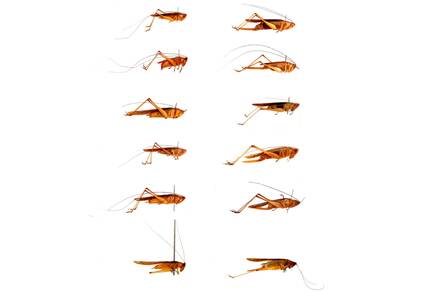
3 new species of ‘musical’ katydids discovered in Kashmir
In a groundbreaking discovery, researchers surveying the lush meadows of Kashmir have identified three new species of “musical” meadow katydids, previously unrecorded in the region. The findings, which shed new light on the biodiversity of the area, have been published in a recent study. The newly discovered species, belonging to the genus Conocephalus, have been named C usmanii, C nagariensis, and C ganderbali, after detailed analysis and observation.
The research team, comprising entomologists and zoologists, conducted an exhaustive survey of the meadows in Kashmir, a region known for its rich flora and fauna. The team’s efforts were rewarded when they stumbled upon the three new species of katydids, which were found to possess unique characteristics that distinguished them from other known species. The discovery of these new species highlights the importance of continued exploration and research into the natural world, as there is still much to be learned about the diverse range of species that inhabit our planet.
The genus Conocephalus, to which the newly discovered species belong, is commonly referred to as “musical” katydids due to the distinctive sounds they produce. These insects are known for their ability to generate a wide range of frequencies, often used for communication and mating purposes. The sounds produced by katydids are a result of a complex process involving the rubbing of their wings, which creates a series of vibrations that are amplified by their bodies.
The three new species, C usmanii, C nagariensis, and C ganderbali, were named after detailed studies of their morphology, behavior, and habitat. The species were found to inhabit specific regions within Kashmir, with each species exhibiting unique adaptations to its environment. The discovery of these new species has significant implications for our understanding of the evolutionary history of the genus Conocephalus and the biodiversity of the region.
In addition to the three new species, the research team also recorded several other known katydid species in the region that were not previously documented there. One such species, C longipennis, was found to be widespread in the area, with its presence previously unrecorded in Kashmir. The discovery of these additional species highlights the importance of continued research and exploration, as even in well-studied regions, new discoveries can still be made.
The discovery of the three new species of “musical” katydids in Kashmir is a significant finding, not only for the field of entomology but also for our understanding of the natural world. The study highlights the importance of preserving and protecting natural habitats, such as the meadows of Kashmir, which are home to a diverse range of species. The loss of these habitats could have significant consequences for the survival of these species, and the ecosystem as a whole.
The research team’s findings have been published in a recent study, which provides a detailed account of the discovery and characteristics of the three new species. The study, which includes photographs and illustrations of the species, is an important contribution to the field of entomology and will be of interest to researchers and scientists working in the field.
In conclusion, the discovery of the three new species of “musical” katydids in Kashmir is a significant finding that highlights the importance of continued research and exploration into the natural world. The study demonstrates the significance of preserving and protecting natural habitats, such as the meadows of Kashmir, which are home to a diverse range of species. As we continue to learn more about the natural world, we are reminded of the importance of conservation and the need to protect these fragile ecosystems for future generations.
For more information on this study, please visit: https://mapress.com/zt/article/view/zootaxa.5737.4.4
About the Author