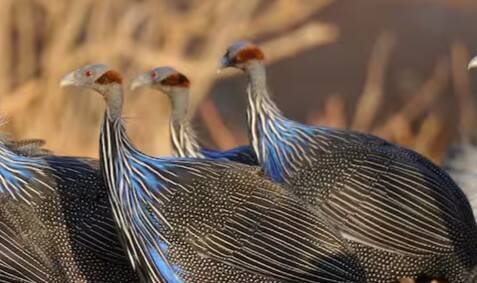
Vulturine Guinea Fowl Uses Light to Look Blue Instead of Pigment
The natural world is full of fascinating examples of how living organisms have evolved to adapt to their environments. One such example is the vulturine guinea fowl, a bird species found in the savannas of East Africa. What makes this bird particularly interesting is its striking electric blue feathers, which are not just a result of pigmentation, but rather a remarkable example of structural coloration. In this blog post, we will delve into the science behind the vulturine guinea fowl’s blue feathers and explore how this unique characteristic helps the bird survive and thrive in its natural habitat.
At first glance, the vulturine guinea fowl’s blue feathers appear to be the result of pigmentation, similar to how many other birds and animals get their color. However, scientists have discovered that the blue coloration of the vulturine guinea fowl’s feathers is not due to the presence of any pigment. Instead, the color is created by the microscopic structure of the feathers themselves. The feathers contain tiny, intricate structures that scatter light in such a way that only blue wavelengths are reflected, giving the appearance of a bright, electric blue color.
This phenomenon is known as structural coloration, and it is a common occurrence in the natural world. Many animals, including birds, insects, and fish, use structural coloration to create a wide range of colors and effects. However, the vulturine guinea fowl’s blue feathers are particularly notable for their intensity and uniformity. The microscopic structures responsible for the coloration are so precise that they can create a blue color that is almost identical to that produced by pigmentation.
So, why is the vulturine guinea fowl’s structural coloration so important? For one, it plays a crucial role in the bird’s communication and social behavior. In the open savannas where the vulturine guinea fowl lives, visibility is key, and the bird’s bright blue feathers help it to stand out against the drab background. This is particularly important for flock communication, as the birds need to be able to see and recognize each other over long distances. The blue coloration also helps the vulturine guinea fowl to attract mates and establish dominance within the flock.
In addition to its role in communication, the vulturine guinea fowl’s structural coloration also helps the bird to survive in its environment. The open savannas of East Africa can be a challenging place to live, with intense sunlight, limited shade, and a variety of predators. The vulturine guinea fowl’s blue feathers help it to blend in with the sky, making it more difficult for predators to spot. The coloration also helps the bird to regulate its body temperature, as the blue feathers reflect sunlight and heat, keeping the bird cool in the hot savanna sun.
The vulturine guinea fowl’s unique structural coloration is not just of interest to biologists and bird enthusiasts. The bird’s remarkable feathers are also inspiring research in optics and materials science. Scientists are studying the microscopic structures responsible for the coloration, with the goal of developing new materials and technologies that can mimic the bird’s remarkable ability to create color without pigment. This research has the potential to lead to breakthroughs in a wide range of fields, from textiles and cosmetics to biomedical devices and aerospace engineering.
In conclusion, the vulturine guinea fowl’s electric blue feathers are a remarkable example of the natural world’s ability to inspire and amaze us. The bird’s unique structural coloration is not just a beautiful phenomenon, but also an important adaptation that helps the bird to survive and thrive in its environment. As we continue to study and learn from the vulturine guinea fowl, we may uncover even more secrets about the natural world and the incredible diversity of life on Earth.
About the Author