Vulturine Guinea Fowl Uses Light to Look Blue Instead of Pigment
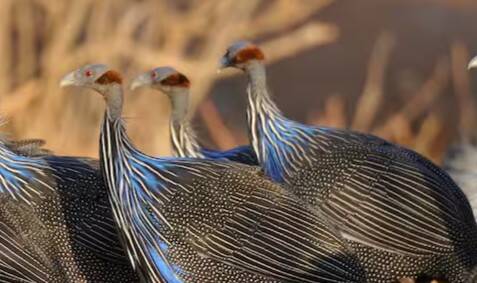
The natural world is full of fascinating creatures, each with unique characteristics that have evolved to help them survive and thrive in their environments. One such creature is the vulturine guinea fowl, a bird found in the open savannas of East Africa. What makes this bird particularly interesting is its striking electric blue feathers, which have been found to contain no pigment. Instead, scientists have discovered that the colour of the vulturine guinea fowl’s feathers comes from microscopic structures that scatter light, reflecting only blue wavelengths.
This phenomenon is known as structural colour, which is a property of certain materials that can produce colours without the use of pigments. In the case of the vulturine guinea fowl, the microscopic structures in its feathers are made up of tiny, plate-like melanosomes that reflect light. These melanosomes are arranged in a specific pattern, which allows them to scatter light in such a way that only blue wavelengths are reflected, giving the feathers their distinctive colour.
The use of structural colour by the vulturine guinea fowl is not just a matter of aesthetics; it also plays a crucial role in the bird’s communication and survival. In the open savannas where the vulturine guinea fowl lives, visibility is key, and the bird’s bright blue feathers help it to stand out against the dull brown and green background. This is particularly important for flock communication, as the birds need to be able to see each other from a distance in order to coordinate their actions and stay together.
But how exactly do the microscopic structures in the vulturine guinea fowl’s feathers produce the blue colour? The answer lies in the way that light interacts with the melanosomes. When light hits the feathers, it is scattered in all directions by the melanosomes, but the blue wavelengths are scattered more than any other colour. This is because the melanosomes are arranged in a specific pattern that allows them to resonate with blue light, amplifying its intensity and reflecting it back to the observer.
The discovery of the vulturine guinea fowl’s structural colour has significant implications for our understanding of the natural world and the evolution of animal colouration. It also has potential applications in fields such as optics and materials science, where researchers are seeking to develop new materials and technologies that can mimic the properties of structural colour.
For example, scientists are currently working on developing new types of paint and coatings that can produce colours without the use of pigments. These materials could have a wide range of applications, from creating more efficient solar cells to developing new types of camouflage materials. The study of structural colour in the vulturine guinea fowl and other animals is providing valuable insights into the underlying physics and biology of this phenomenon, and is helping to drive innovation in these fields.
In addition to its potential applications in technology, the vulturine guinea fowl’s structural colour is also an important area of study in the field of biology. By understanding how the bird’s feathers produce their blue colour, scientists can gain insights into the evolution of animal colouration and the ways in which different species use colour to communicate and survive.
The vulturine guinea fowl is not the only animal that uses structural colour to produce its distinctive hues. Many other birds, insects, and even fish have been found to use similar mechanisms to produce a wide range of colours, from the iridescent blues and greens of butterfly wings to the bright reds and oranges of certain types of coral.
However, the vulturine guinea fowl is one of the most striking examples of structural colour in the natural world, and its study is providing valuable insights into the biology and physics of this phenomenon. As scientists continue to learn more about the vulturine guinea fowl and its remarkable feathers, they are also gaining a deeper appreciation for the beauty and complexity of the natural world.
In conclusion, the vulturine guinea fowl’s use of light to produce its blue colour is a fascinating example of the natural world’s ability to inspire and surprise us. Through the study of this phenomenon, scientists are gaining a deeper understanding of the biology and physics of structural colour, and are developing new technologies and materials that can mimic its properties. As we continue to learn more about the vulturine guinea fowl and its remarkable feathers, we are reminded of the importance of preserving and protecting the natural world, and of the many wonders that it still holds.
About the Author