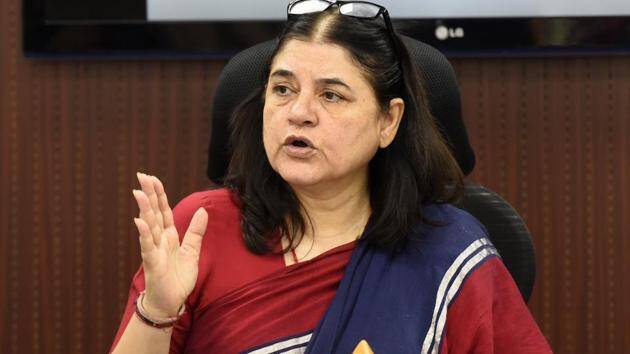
Those bursting crackers should be called ‘anti-national’: Maneka
As the festive season approaches, the debate around firecrackers and their impact on the environment has once again gained momentum. BJP leader Maneka Gandhi has sparked a controversy by calling for a nationwide ban on firecrackers, citing the severe air pollution in New Delhi as the primary reason. According to Gandhi, the bursting of firecrackers is not only harmful to the environment but also to the health of citizens, and those who engage in such activities should be labeled as “anti-national”.
Gandhi’s statement comes at a time when the national capital is struggling to cope with severe air pollution. The city’s air quality has been deteriorating over the years, and the situation worsens during the festive season when firecrackers are burst in large numbers. The BJP leader’s comments have sparked a heated debate, with many people taking to social media to express their opinions on the matter.
The issue of firecrackers and air pollution is not new to India. The country has been grappling with the problem of air pollution for decades, and the situation has only worsened over the years. The burning of firecrackers during festivals like Diwali releases large amounts of pollutants into the air, including particulate matter, carbon monoxide, and sulfur dioxide. These pollutants can cause respiratory problems, cardiovascular disease, and even cancer.
Gandhi’s suggestion that those who burst firecrackers should be called “anti-national” has been met with both support and criticism. While some people agree that the bursting of firecrackers is a serious issue that needs to be addressed, others feel that Gandhi’s comments are an overreaction. Some have argued that firecrackers are an integral part of Indian culture and that a ban on them would be an attack on the country’s traditions.
However, Gandhi’s comments should not be seen as an attack on Indian culture, but rather as a call to action to protect the environment and public health. The fact that firecrackers worth ₹800 crore are burst in just two nights is a staggering figure, and it is estimated that the air pollution caused by these firecrackers can last for several days. The impact of air pollution on public health is well-documented, and it is estimated that thousands of people die every year due to air pollution-related illnesses.
The government has a crucial role to play in addressing the issue of air pollution caused by firecrackers. While a ban on firecrackers may not be a practical solution, the government can take steps to regulate their use and reduce the impact of air pollution. For example, the government can impose strict rules on the sale and use of firecrackers, and ensure that only eco-friendly firecrackers are available in the market.
Additionally, the government can launch public awareness campaigns to educate people about the dangers of air pollution and the importance of protecting the environment. Schools and educational institutions can also play a crucial role in spreading awareness about the issue and promoting eco-friendly practices.
In conclusion, Maneka Gandhi’s comments on firecrackers and air pollution have sparked an important debate in the country. While some people may disagree with her suggestion that those who burst firecrackers should be called “anti-national”, it is undeniable that the issue of air pollution is a serious one that needs to be addressed. The government, civil society, and individuals must work together to find solutions to this problem and protect the environment and public health.
As we celebrate our festivals and traditions, it is essential that we do so in a responsible and sustainable manner. We must recognize the impact of our actions on the environment and take steps to reduce our carbon footprint. By working together, we can create a cleaner, greener, and healthier India for future generations.
Source: https://repository.inshorts.com/articles/en/PTI/05dfed30-2874-4e50-8c78-37383df29516
About the Author