Vulturine Guinea Fowl Uses Light to Look Blue Instead of Pigment
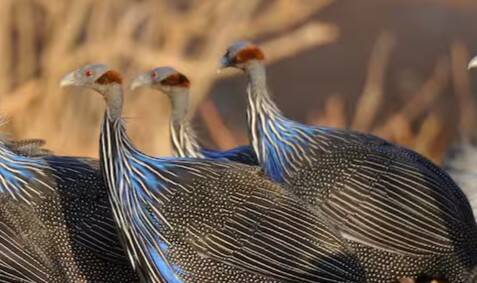
The natural world is full of fascinating phenomena, and the vulturine guinea fowl is a prime example of this. This bird’s electric blue feathers are a sight to behold, but what’s even more remarkable is that they contain no pigment. Scientists have discovered that the colour of the vulturine guinea fowl’s feathers comes from microscopic structures that scatter light, reflecting only blue wavelengths. This unique phenomenon has important implications for the bird’s communication and survival in its open savanna habitat, and is also inspiring research in optics and materials science.
The vulturine guinea fowl is a large, ground-dwelling bird that is native to the savannas of eastern Africa. It is known for its striking appearance, with a grey and white body and electric blue feathers on its neck and chest. These blue feathers are not just for show; they play a crucial role in the bird’s communication and social behaviour. The colour of the feathers helps to identify individual birds and convey information about their status, age, and sex.
But how do the vulturine guinea fowl’s feathers get their blue colour? The answer lies in the microscopic structure of the feathers themselves. The barbs and barbules of the feathers are made up of tiny, branching filaments that reflect light. When light hits these filaments, it is scattered in all directions, but the shorter, blue wavelengths are reflected back to the viewer, giving the feathers their characteristic blue colour. This phenomenon is known as structural colour, and it is found in a wide range of animals, from butterflies and birds to fish and reptiles.
The structural colour of the vulturine guinea fowl’s feathers is not just a curiosity; it has important implications for the bird’s survival and behaviour. In the open savannas where the vulturine guinea fowl lives, communication and social interaction are crucial for finding food, avoiding predators, and mating. The blue colour of the feathers helps to facilitate this communication, allowing individual birds to recognize and interact with each other over long distances.
The vulturine guinea fowl’s use of structural colour is also inspiring research in optics and materials science. Scientists are studying the microscopic structure of the feathers to understand how they produce their blue colour, and to develop new materials and technologies that can mimic this effect. This research has the potential to lead to breakthroughs in a wide range of fields, from optics and photonics to biotechnology and nanotechnology.
One of the key advantages of structural colour is that it is more efficient and sustainable than traditional pigments. Unlike pigments, which can fade or degrade over time, structural colour is durable and long-lasting, and does not require the use of toxic or expensive materials. This makes it an attractive option for a wide range of applications, from textiles and coatings to displays and sensors.
In addition to its potential applications in materials science, the vulturine guinea fowl’s use of structural colour is also inspiring new approaches to the study of animal behaviour and ecology. By understanding how the bird’s blue feathers are used for communication and social interaction, scientists can gain insights into the complex social dynamics of the vulturine guinea fowl and other animals.
In conclusion, the vulturine guinea fowl’s use of light to look blue instead of pigment is a fascinating phenomenon that has important implications for our understanding of animal behaviour, ecology, and materials science. The bird’s unique feathers are not just a curiosity; they are a key component of its communication and social behaviour, and are inspiring new research and innovations in a wide range of fields. As we continue to study and learn from the natural world, we may uncover even more surprising and remarkable phenomena that challenge our assumptions and inspire new discoveries.
About the Author