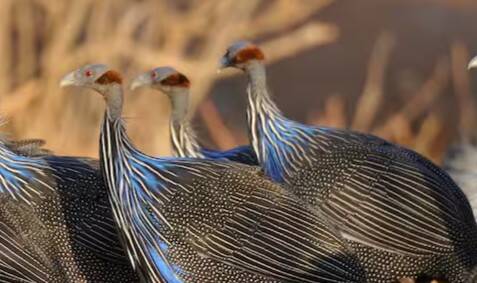
Vulturine Guinea Fowl Uses Light to Look Blue Instead of Pigment
The natural world is full of fascinating creatures, each with unique characteristics that have evolved to help them survive and thrive in their environments. One such creature is the vulturine guinea fowl, a bird known for its striking electric blue feathers. However, what makes this bird truly remarkable is that its blue coloration is not due to the presence of pigments, but rather the way its feathers interact with light.
The vulturine guinea fowl’s feathers contain microscopic structures that scatter light, reflecting only blue wavelengths and giving the appearance of a vibrant blue color. This phenomenon is known as structural coloration, and it is a remarkable example of how nature can create complex and beautiful effects without the need for pigments.
The vulturine guinea fowl’s structural coloration is not just aesthetically pleasing; it also plays a crucial role in the bird’s communication and survival. In the open savannas where the bird lives, its bright blue feathers serve as a visual signal to other members of its flock, helping to maintain social bonds and warning potential predators to stay away. The bird’s striking plumage is also an important factor in its ability to attract mates and establish dominance within its social hierarchy.
But the vulturine guinea fowl’s unique feathers are not just interesting from a biological perspective; they are also inspiring research in the fields of optics and materials science. Scientists are studying the microscopic structures that create the bird’s structural coloration, with the goal of developing new materials and technologies that can mimic this effect.
One of the key challenges in creating materials that exhibit structural coloration is understanding the complex interactions between light, matter, and geometry. The vulturine guinea fowl’s feathers are made up of tiny, branching melanin filaments that reflect light and create the appearance of blue coloration. By studying the arrangement and structure of these filaments, scientists hope to gain insights into how to create similar effects in synthetic materials.
Potential applications for materials that exhibit structural coloration are numerous and varied. For example, such materials could be used to create more efficient and sustainable displays for electronic devices, or to develop new types of coatings and paints that can change color in response to environmental stimuli. The study of the vulturine guinea fowl’s feathers is also inspiring research into the development of new optical materials and devices, such as ultra-compact lasers and high-efficiency solar cells.
In addition to its potential applications in materials science, the study of the vulturine guinea fowl’s structural coloration is also shedding new light on the evolution of coloration in birds. By examining the microscopic structures that create the bird’s blue feathers, scientists are gaining a better understanding of how different species have developed unique coloration patterns over time.
The vulturine guinea fowl’s electric blue feathers are a remarkable example of the complexity and beauty of the natural world. Through the study of this bird’s unique characteristics, scientists are gaining insights into the intricate relationships between light, matter, and geometry, and are developing new materials and technologies that have the potential to transform a wide range of fields.
In conclusion, the vulturine guinea fowl’s use of light to create its striking blue coloration is a fascinating example of the natural world’s ability to inspire and inform scientific research. As scientists continue to study the microscopic structures that create the bird’s structural coloration, they are gaining a deeper understanding of the complex interactions between light, matter, and geometry, and are developing new materials and technologies that have the potential to transform a wide range of fields.
About the Author