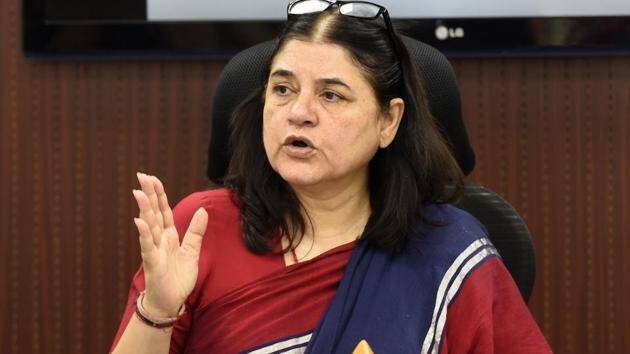
Those bursting crackers should be called ‘anti-national’: Maneka
As the festive season approaches, the debate around firecrackers and their impact on the environment has once again gained momentum. BJP leader Maneka Gandhi has weighed in on the issue, calling for a nationwide ban on firecrackers and labeling those who burst them as “anti-national”. In a statement that has sparked a heated discussion, Gandhi emphasized the need to address the growing problem of air pollution in New Delhi, which she believes is largely caused by the bursting of firecrackers.
According to Gandhi, the sheer scale of firecracker usage during festivals is staggering, with an estimated ₹800 crore worth of firecrackers being burst in just two nights. The environmental impact of such large-scale firecracker usage is devastating, with the air quality in New Delhi plummeting to hazardous levels. “If you will burst firecrackers worth ₹800 crore in two nights, then what will happen to the air?” Gandhi asked, highlighting the urgent need for action to mitigate the effects of air pollution.
Gandhi’s statement has sparked a lively debate, with many arguing that a nationwide ban on firecrackers is a drastic measure that would have significant social and cultural implications. Firecrackers have been an integral part of Indian festivals, particularly Diwali, for centuries, and many people see them as an essential part of the celebrations. However, Gandhi’s argument is that the environmental cost of firecracker usage far outweighs any cultural or social benefits.
The issue of air pollution in New Delhi is a pressing concern, with the city consistently ranking among the most polluted cities in the world. The air quality in New Delhi is often hazardous, particularly during the winter months, when a combination of factors such as vehicle emissions, industrial pollution, and crop burning contribute to a toxic mix of pollutants in the air. The bursting of firecrackers during festivals only exacerbates the problem, releasing large amounts of particulate matter, carbon monoxide, and other pollutants into the air.
Gandhi’s call for a nationwide ban on firecrackers is not without precedent. Several cities and states in India have already imposed restrictions on firecracker usage, and some have even banned them altogether. The Supreme Court has also weighed in on the issue, imposing restrictions on firecracker usage during festivals. However, a nationwide ban would require a coordinated effort from governments, civil society, and individuals to implement and enforce.
One of the key challenges in implementing a ban on firecrackers is the cultural and social significance attached to them. Firecrackers have been a part of Indian festivals for centuries, and many people see them as an essential part of the celebrations. However, Gandhi’s argument is that the environmental cost of firecracker usage is too high to ignore, and that alternative methods of celebration can be found.
In recent years, there has been a growing movement towards more environmentally friendly and sustainable methods of celebration. Many people are opting for eco-friendly firecrackers, which are designed to produce fewer pollutants and less noise. Others are choosing to celebrate festivals without firecrackers altogether, instead opting for more low-key and environmentally friendly methods of celebration.
Gandhi’s statement has also sparked a debate about the role of individual responsibility in addressing environmental issues. While governments and institutions have a critical role to play in implementing policies and regulations to mitigate the effects of pollution, individuals also have a responsibility to make environmentally conscious choices. By choosing not to burst firecrackers, individuals can contribute to a larger movement towards a more sustainable and environmentally friendly way of living.
In conclusion, Maneka Gandhi’s call for a nationwide ban on firecrackers has sparked a necessary debate about the environmental impact of firecracker usage. While a ban may be a drastic measure, it highlights the urgent need for action to address the growing problem of air pollution in New Delhi. As individuals, we have a responsibility to make environmentally conscious choices, and to consider the impact of our actions on the environment. By working together, we can create a more sustainable and environmentally friendly future for ourselves and for future generations.
News Source: https://repository.inshorts.com/articles/en/PTI/05dfed30-2874-4e50-8c78-37383df29516
About the Author