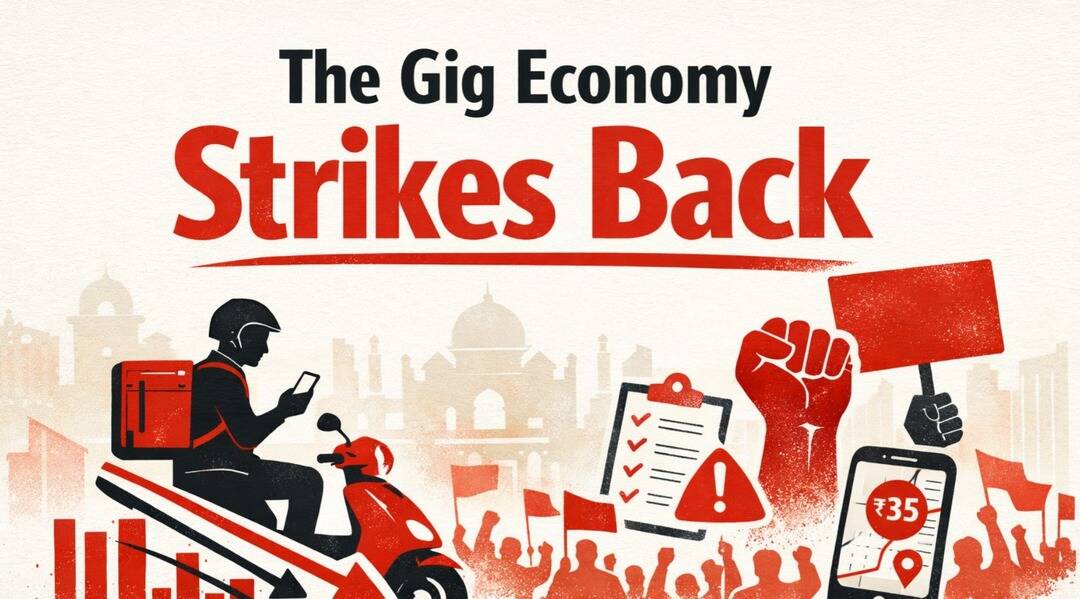
Indian gig economy strikes back, exposing a broken model
The Indian gig economy, which has been thriving in recent years, has hit a roadblock. In December, around 40,000 delivery workers joined nationwide strikes, disrupting 50–60% of orders in several cities. The workers, who are the backbone of the gig economy, cited low and unstable pay, strict app control, and weak protections as the reasons for their protest. This strike has brought to the forefront the widening gap between convenience and fairness in India’s digital jobs.
The gig economy, which includes companies like Zomato, Swiggy, and Uber, has been growing rapidly in India. These companies have made it convenient for people to order food, book cabs, and avail other services with just a few clicks on their smartphones. However, the workers who make this convenience possible are struggling to make ends meet. They are not treated as employees, but rather as independent contractors, which means they do not have access to basic benefits like health insurance, paid leave, and job security.
The strike, which was called by various worker unions, highlighted the plight of these workers. They complained that their pay has been reduced over time, and they are forced to work long hours without any breaks. They also alleged that the companies are using algorithms to control their work, which makes it difficult for them to earn a decent living. The workers are also concerned about their safety, as they are often forced to work in hazardous conditions without any protection.
The companies, on the other hand, have defended their growth model, saying that it provides flexibility and opportunities for workers to earn a living. They argue that the workers are not employees, but rather partners who can choose when and how much they want to work. However, this argument does not hold water, as the workers are clearly at the mercy of the companies. They are forced to work long hours, and their pay is determined by the companies’ algorithms.
The strike has also caught the attention of politicians, who are trying to intervene in the matter. The government has announced that it will set up a panel to look into the issues faced by gig workers. However, it remains to be seen whether the panel will be able to address the concerns of the workers. The government has also been criticized for not doing enough to protect the rights of gig workers.
The Indian gig economy strike is not an isolated incident. Similar strikes have taken place in other countries, including the United States and the United Kingdom. The strikes highlight the need for a new model of work, one that balances convenience with fairness. The companies need to recognize that their workers are not just cogs in a machine, but human beings who deserve to be treated with dignity and respect.
The strike has also raised questions about the role of technology in the gig economy. While technology has made it possible for companies to operate with a large number of workers, it has also created a system of exploitation. The algorithms used by the companies are designed to maximize profits, without regard for the well-being of the workers. This has created a system of surveillance, where workers are constantly monitored and controlled.
To address these issues, the companies need to adopt a more humane approach. They need to recognize that their workers are not just independent contractors, but human beings who deserve to be treated with dignity and respect. They need to provide their workers with better pay, benefits, and job security. They also need to give their workers more control over their work, allowing them to choose when and how much they want to work.
The government also needs to play a role in regulating the gig economy. It needs to set up laws and regulations that protect the rights of gig workers. It needs to ensure that the companies are not exploiting their workers, and that they are providing them with fair pay and benefits. The government also needs to provide support to gig workers, such as training and education programs, to help them upgrade their skills and improve their livelihoods.
In conclusion, the Indian gig economy strike has highlighted the need for a new model of work, one that balances convenience with fairness. The companies need to adopt a more humane approach, recognizing that their workers are not just cogs in a machine, but human beings who deserve to be treated with dignity and respect. The government also needs to play a role in regulating the gig economy, setting up laws and regulations that protect the rights of gig workers. Only then can we create a gig economy that is fair, equitable, and sustainable for all.
News Source: https://ascendants.in/industry_events/indian-gig-economy-strikes-platforms-policy/
About the Author