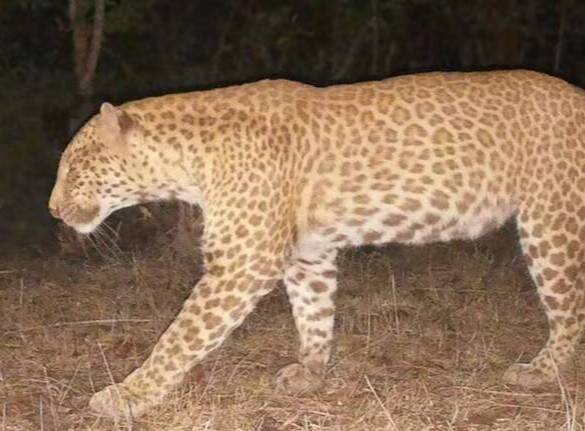
Rare ‘sandalwood leopard’ spotted for the first time in Karnataka
In a groundbreaking discovery, researchers in Karnataka have documented an ultra-rare leopard colour morph in Vijayanagara district, marking only the second confirmed sighting of such a big cat in India and the first in the state. The animal, named the ‘Sandalwood Leopard’ by conservationists, is distinguished by a pale reddish-pink coat with light-brown rosettes. This extraordinary finding has sent shockwaves of excitement throughout the scientific community, and wildlife enthusiasts are eager to learn more about this elusive creature.
The Sandalwood Leopard, as it has been dubbed, is a variant of the Indian leopard (Panthera pardus fusca), a subspecies of leopard found in the Indian subcontinent. While leopards are known for their striking coats, which typically feature a yellow or golden background with dark spots or rosettes, the Sandalwood Leopard’s unique colouration sets it apart from its more common counterparts. The pale reddish-pink hue of its coat, combined with the light-brown rosettes, gives the animal a distinctive appearance that is unlike any other known leopard colour morph.
The discovery of the Sandalwood Leopard was made by wildlife scientist Sanjay Gubbi, who has been studying leopards in Karnataka for many years. Gubbi, who is renowned for his work on leopard conservation, had been tracking the animal in the Vijayanagara district when he finally caught a glimpse of it. The sighting was a momentous occasion, as it marked the first time that a Sandalwood Leopard had been spotted in Karnataka, and only the second time that such an animal had been documented in India.
The first recorded sighting of a Sandalwood Leopard was made in 2019, in the nearby state of Tamil Nadu. However, the sighting was not well-documented, and the animal was not photographed or filmed. In contrast, Gubbi’s sighting of the Sandalwood Leopard in Karnataka was extensively documented, with high-quality photographs and video footage captured. This has allowed scientists to study the animal’s appearance and behavior in greater detail, and has provided valuable insights into the biology and ecology of this rare colour morph.
The discovery of the Sandalwood Leopard has significant implications for conservation efforts in Karnataka and beyond. Leopards are an important part of their ecosystems, playing a vital role in maintaining the balance of nature. However, they are also threatened by habitat loss, human-wildlife conflict, and poaching, which has led to a decline in their populations in recent years. The discovery of the Sandalwood Leopard highlights the need for continued conservation efforts, and demonstrates the importance of protecting and preserving the natural habitats of these magnificent animals.
In addition to its conservation significance, the discovery of the Sandalwood Leopard has also sparked interest and excitement among wildlife enthusiasts and the general public. The animal’s unique appearance, combined with its elusive nature, has captivated the imagination of many, and has inspired a new wave of interest in leopard conservation. As news of the discovery spreads, it is likely that the Sandalwood Leopard will become an iconic symbol of Karnataka’s rich biodiversity, and a source of pride for the state’s conservation community.
The discovery of the Sandalwood Leopard is also a testament to the importance of scientific research and documentation in conservation efforts. Gubbi’s dedication to studying leopards in Karnataka, and his commitment to documenting his findings, have made it possible for us to learn more about this rare and elusive animal. As we continue to face the challenges of conservation in the 21st century, it is clear that scientific research and documentation will play an increasingly important role in protecting and preserving our planet’s precious biodiversity.
In conclusion, the discovery of the Sandalwood Leopard in Karnataka is a remarkable finding that highlights the importance of conservation efforts and the need to protect and preserve our natural world. The animal’s unique appearance, combined with its elusive nature, makes it a fascinating subject for study and observation, and its discovery is a testament to the dedication and hard work of wildlife scientists like Sanjay Gubbi. As we continue to learn more about the Sandalwood Leopard, it is clear that this animal will remain an important part of our conservation efforts, and a powerful symbol of the beauty and diversity of the natural world.
About the Author