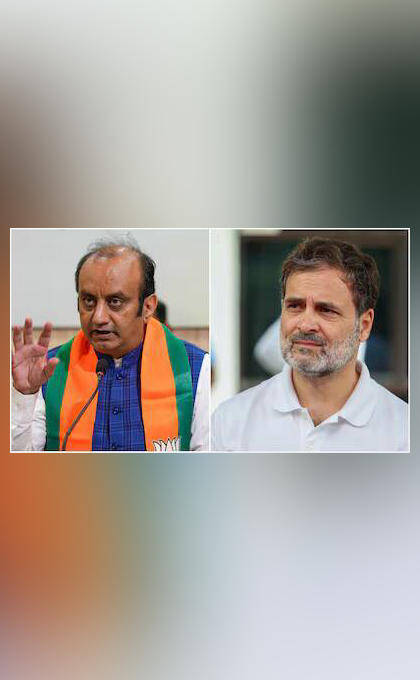
Rahul’s Vietnam visit will be as ‘guest of anti-India people’: BJP
The Bharatiya Janata Party (BJP) has recently made some scathing allegations against Congress leader Rahul Gandhi, claiming that his recent visit to Vietnam is as a guest of individuals who harbor anti-India sentiments. This statement was made by BJP leader Sudhanshu Trivedi, who also accused Gandhi of traveling abroad with the sole intention of making anti-India statements. According to Trivedi, Gandhi’s trip to Vietnam is a continuation of his efforts to “spew venom” against India on foreign soil.
Trivedi’s allegations come on the heels of Gandhi’s recent visit to Germany, where the BJP claims he met with individuals who are “enemies of India.” The BJP has been vocal in its criticism of Gandhi’s foreign visits, accusing him of using these opportunities to undermine India’s reputation and interests abroad. The party has also suggested that Gandhi’s actions are a betrayal of the country’s trust and a reflection of his own lack of patriotism.
The BJP’s allegations against Gandhi are not new, and the party has been consistently critical of his foreign visits and statements. However, the latest allegations take on a new level of significance, given the current geopolitical climate and India’s increasingly important role on the global stage. As India seeks to assert its influence and interests abroad, the BJP’s accusations against Gandhi suggest that the Congress leader’s actions could be seen as a hindrance to these efforts.
It is worth noting that Gandhi’s visit to Vietnam is part of a larger effort by the Congress party to engage with foreign leaders and governments. The party has been seeking to strengthen its ties with countries in the region, with an eye towards building stronger economic and strategic partnerships. However, the BJP’s allegations against Gandhi suggest that the Congress leader’s efforts may be motivated by more sinister intentions.
The BJP’s criticism of Gandhi’s foreign visits is also reflective of the deeper ideological divisions between the two parties. The BJP has long been critical of the Congress party’s approach to foreign policy, accusing it of being weak and ineffective in promoting India’s interests abroad. The BJP, on the other hand, has sought to project itself as a strong and assertive force on the global stage, with a commitment to protecting India’s sovereignty and interests.
In this context, the BJP’s allegations against Gandhi can be seen as an attempt to undermine the Congress party’s credibility on foreign policy issues. By accusing Gandhi of making anti-India statements abroad, the BJP is seeking to suggest that the Congress party is not committed to promoting India’s interests and is instead willing to compromise the country’s sovereignty for the sake of political gain.
However, it is also possible to see the BJP’s allegations against Gandhi as a reflection of the party’s own insecurities and fears. The BJP has been facing increasing criticism and scrutiny over its handling of foreign policy issues, particularly with regards to its approach to countries like China and Pakistan. By accusing Gandhi of making anti-India statements abroad, the BJP may be seeking to deflect attention away from its own shortcomings and failures on the foreign policy front.
Ultimately, the truth behind the BJP’s allegations against Gandhi remains to be seen. However, one thing is clear: the controversy surrounding Gandhi’s foreign visits is unlikely to die down anytime soon. As the BJP and Congress party continue to trade barbs and accusations, the country will be watching with bated breath to see how this saga unfolds.
In conclusion, the BJP’s allegations against Rahul Gandhi’s visit to Vietnam are a serious matter that warrants close attention and scrutiny. While the party’s accusations against Gandhi may be motivated by political considerations, they also reflect deeper ideological divisions and competing visions for India’s role on the global stage. As the country navigates an increasingly complex and rapidly changing world, it is essential that our leaders prioritize the national interest and work towards building a stronger, more assertive India.
News Source: https://repository.inshorts.com/articles/en/PTI/2ea66af0-d391-4b15-b095-5b63f4789282
About the Author