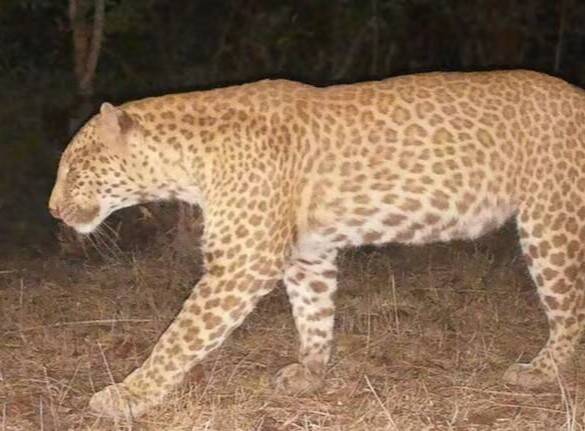
Rare ‘sandalwood leopard’ spotted for the first time in Karnataka
In a groundbreaking discovery, researchers in Karnataka have documented an ultra-rare leopard colour morph in Vijayanagara district, marking only the second confirmed sighting of such a big cat in India and the first in the state. The animal, named the ‘Sandalwood Leopard’ by conservationists, is distinguished by a pale reddish-pink coat with light-brown rosettes. This extraordinary finding has sent shockwaves of excitement throughout the scientific community, and we are thrilled to delve into the details of this remarkable discovery.
The ‘Sandalwood Leopard’ was spotted by renowned wildlife scientist Sanjay Gubbi, who has dedicated his career to studying and conserving India’s rich wildlife. Gubbi’s team has been conducting extensive research in the Vijayanagara district, and their tireless efforts have finally paid off with this incredible sighting. The leopard’s unique coat colouration is unlike anything seen before in the region, and it has left experts fascinated and eager to learn more.
The ‘Sandalwood Leopard’ gets its name from the distinctive pale reddish-pink hue of its coat, which is reminiscent of the prized sandalwood trees that are native to the region. The light-brown rosettes that adorn its fur add to the animal’s striking appearance, making it a truly one-of-a-kind creature. This rare colour morph is a result of a genetic variation that affects the production of melanin, the pigment responsible for skin and hair colour. The exact causes of this variation are still not fully understood and are currently being studied by scientists.
This sighting is not only significant because of the leopard’s rare colouration but also because it highlights the importance of conservation efforts in the region. The Vijayanagara district is home to a diverse range of flora and fauna, and the presence of this elusive leopard is a testament to the area’s rich biodiversity. The discovery of the ‘Sandalwood Leopard’ serves as a reminder of the need to protect and preserve India’s natural heritage, not just for the benefit of the animals that inhabit it but also for the well-being of the ecosystem as a whole.
The ‘Sandalwood Leopard’ is not the only rare animal to be found in Karnataka. The state is home to a wide range of endangered species, including the Bengal tiger, the Indian elephant, and the Asiatic lion. These animals are not only an integral part of the ecosystem but also play a vital role in maintaining the balance of nature. The conservation of these species is crucial, and efforts are being made by the government and various organizations to protect their habitats and prevent human-wildlife conflict.
The discovery of the ‘Sandalwood Leopard’ has also sparked interest among the general public, with many people taking to social media to express their excitement and awe. The sighting has been hailed as a major breakthrough, and it is hoped that it will raise awareness about the importance of conservation and the need to protect India’s wildlife. As news of the ‘Sandalwood Leopard’ spreads, it is likely that more people will become interested in learning about the natural world and the incredible creatures that inhabit it.
In conclusion, the sighting of the ‘Sandalwood Leopard’ in Karnataka is a remarkable discovery that highlights the importance of conservation and the need to protect India’s rich biodiversity. The ‘Sandalwood Leopard’ is an extraordinary animal, and its unique coat colouration makes it a truly special creature. As we continue to learn more about this incredible animal, we are reminded of the need to preserve and protect our natural heritage for future generations.
The discovery of the ‘Sandalwood Leopard’ is a testament to the dedication and hard work of wildlife scientists like Sanjay Gubbi, who have spent years studying and conserving India’s wildlife. Their efforts have paid off, and we are now able to marvel at the beauty and uniqueness of this incredible animal. As we look to the future, it is hoped that the ‘Sandalwood Leopard’ will become an iconic symbol of conservation and a reminder of the importance of protecting our planet’s precious biodiversity.
For more information on this incredible discovery, please visit the original news source:
About the Author