Deepinder claims issue with gig economy is it exposed class divide, says ‘We tip awkwardly’
The gig economy has been a topic of discussion for several years now, with many experts weighing in on its pros and cons. While some argue that it has created new opportunities for workers and increased flexibility, others claim that it has perpetuated exploitation and worsened working conditions. Recently, billionaire Deepinder Goyal, the founder of Zomato, shared his thoughts on the matter, and his comments have sparked a heated debate. According to Goyal, the problem with the gig economy is not its inherent structure, but rather the fact that it has exposed the prevailing class divide in our society.
Goyal’s statement, which was shared on social media, reads, “Suddenly, poor aren’t hidden away…Now, every doorbell is a reminder of systemic inequality.” He further added, “We aren’t just debating economics, we’re confronting guilt…We tip awkwardly…because inequality is no longer abstract.” These words highlight the uncomfortable truth that the gig economy has brought to the forefront. By ensuring that workers are seen by the consuming class, the gig economy has made it impossible to ignore the stark contrast between the haves and have-nots.
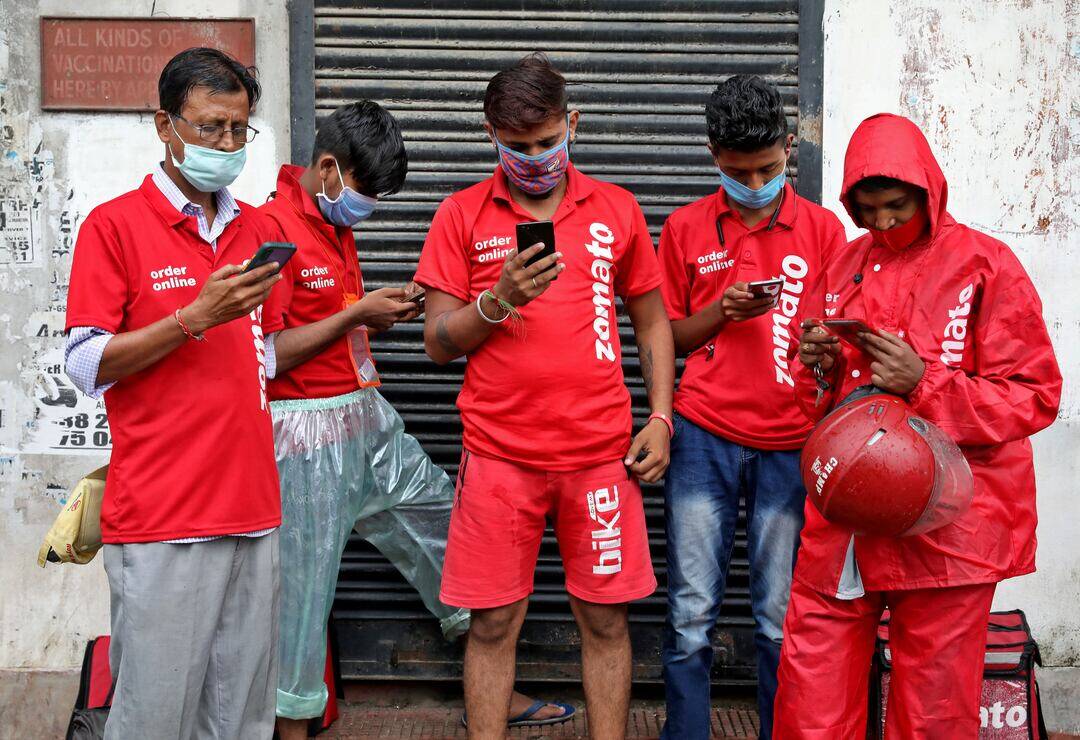
In the past, the wealthy and the poor existed in separate spheres, with minimal interaction between the two. However, with the rise of the gig economy, this separation is no longer possible. Food delivery workers, ride-hailing drivers, and other gig workers are now an integral part of our daily lives, and their presence serves as a constant reminder of the economic disparities that exist in our society. As Goyal so aptly put it, “every doorbell is a reminder of systemic inequality.” This phenomenon has made it increasingly difficult for people to turn a blind eye to the struggles of those who are less fortunate.
The fact that we are forced to confront the reality of economic inequality has led to a sense of guilt and discomfort. This is evident in the way we interact with gig workers. For instance, when we order food online, we are often prompted to leave a tip for the delivery person. However, this gesture, which is meant to be a kind and generous act, can also be seen as a way of alleviating our own guilt. As Goyal said, “We tip awkwardly…because inequality is no longer abstract.” This awkwardness stems from the fact that we are aware of the economic disparities that exist, and we are unsure of how to address them.
Moreover, the gig economy has also highlighted the exploitation of workers, which is a direct result of the class divide. Many gig workers are forced to work long hours for minimal pay, without access to basic benefits like healthcare and social security. This exploitation is a consequence of the power dynamic that exists between the wealthy and the poor. Those who have the means to exploit others often do so, without regard for the well-being of the workers. The gig economy has brought this exploitation to the forefront, making it impossible to ignore.
Furthermore, the gig economy has also perpetuated the idea that certain jobs are beneath others. For instance, food delivery workers and ride-hailing drivers are often seen as being at the bottom of the social ladder. This perception is a result of the class divide, which dictates that certain jobs are more prestigious than others. However, the reality is that all work is valuable, and every worker deserves to be treated with dignity and respect. The gig economy has highlighted the need to challenge these societal norms and to recognize the worth of all workers, regardless of their occupation.
In conclusion, Deepinder Goyal’s comments on the gig economy have shed light on a critical issue that affects us all. The fact that the gig economy has exposed the class divide in our society is a wake-up call, and it is essential that we take heed. By acknowledging the economic disparities that exist, we can begin to work towards creating a more equitable society, where every worker is treated with dignity and respect. As Goyal so eloquently put it, “We aren’t just debating economics, we’re confronting guilt.” It is time for us to confront this guilt and to take action to address the systemic inequality that exists in our society.
News source: https://x.com/deepigoyal/status/2007030873711927381
About the Author