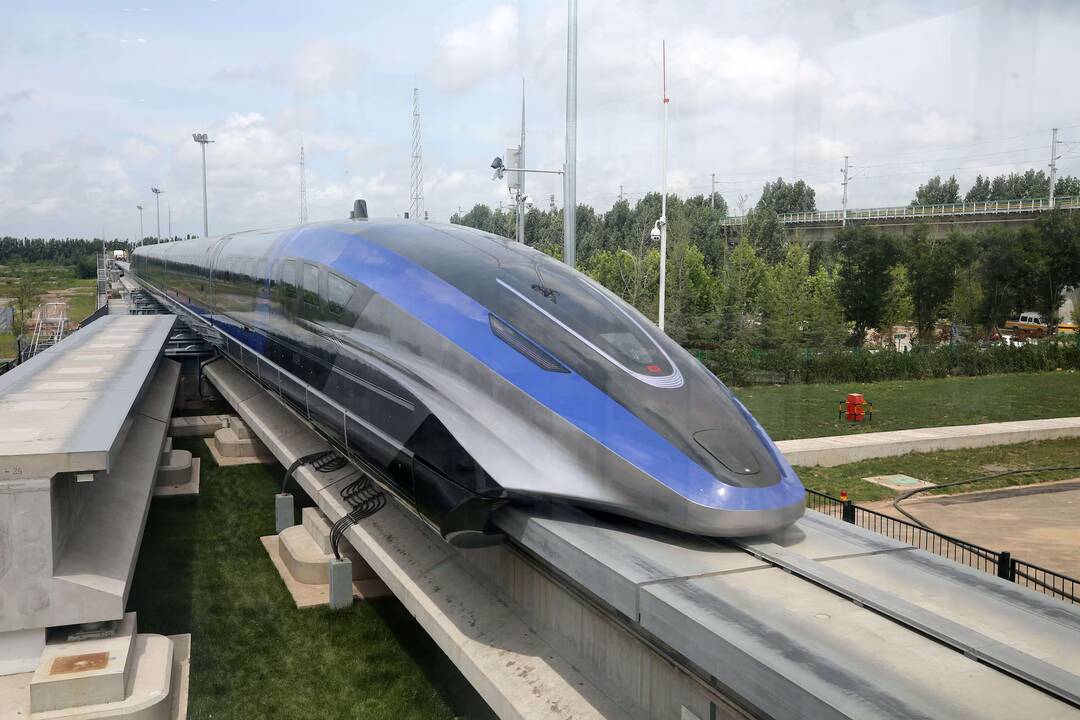
China Accelerates Vehicle to 700 km/h in 2 Secs in Magnetic Levitation Test
In a groundbreaking achievement, researchers in China have successfully accelerated a tonne-class vehicle to a speed of 700 km/h within a mere two seconds on a magnetic levitation (maglev) test line. This remarkable feat makes it the fastest superconductive electric maglev system in the world, according to state broadcaster China Central Television. The test was conducted by China’s National University of Defense Technology using a 1,310-foot track, showcasing the country’s advancements in transportation technology.
The maglev system uses electromagnetic forces to propel the vehicle forward, eliminating the need for traditional wheels and tracks. This allows for smoother, quieter, and more efficient travel, with reduced friction and wear on the vehicle and track. The system is also capable of reaching incredibly high speeds, making it an attractive option for high-speed transportation.
The test, which was conducted on the specially designed track, saw the vehicle accelerate from 0 to 700 km/h in just two seconds. To put this into perspective, it would take a typical high-speed train over 10 minutes to reach the same speed. The acceleration is so rapid that it would be equivalent to going from 0 to 60 mph in just 0.3 seconds, faster than most sports cars.
The achievement is a significant milestone for China’s transportation industry, which has been investing heavily in maglev technology in recent years. The country has already operationalized several maglev lines, including the Shanghai Maglev Train, which connects the city’s Pudong International Airport to the downtown area. However, this latest test demonstrates the potential for even faster and more efficient travel.
The National University of Defense Technology, which conducted the test, is a leading research institution in China, known for its advancements in fields such as aerospace, robotics, and transportation. The university has been working on the maglev project for several years, with the goal of developing a high-speed transportation system that can compete with the likes of Japan’s famous bullet trains.
The implications of this technology are far-reaching, with potential applications in various fields, including transportation, logistics, and even space exploration. The ability to accelerate vehicles to such high speeds in a short amount of time could revolutionize the way we travel, making long-distance journeys faster, more efficient, and more comfortable.
China’s investment in maglev technology is also seen as a strategic move to enhance its global competitiveness in the transportation sector. The country has been actively promoting its high-speed rail technology, with several countries, including Indonesia, Malaysia, and Thailand, already expressing interest in adopting the technology.
While the test is a significant achievement, there are still several challenges to be addressed before the technology can be commercialized. These include ensuring the safety and reliability of the system, as well as reducing the cost of construction and maintenance. Additionally, the system will require significant infrastructure investment, including the construction of dedicated tracks and stations.
Despite these challenges, the potential benefits of maglev technology make it an exciting area of research and development. As China continues to push the boundaries of what is possible with this technology, we can expect to see significant advancements in the coming years. With its ability to accelerate vehicles to incredible speeds, maglev technology has the potential to transform the way we travel, making it faster, more efficient, and more sustainable.
In conclusion, the successful test of China’s maglev system is a remarkable achievement that demonstrates the country’s commitment to innovation and technological advancement. As the world watches with interest, China is poised to take the lead in the development of high-speed transportation technology, with potential applications that could revolutionize the way we travel.
About the Author