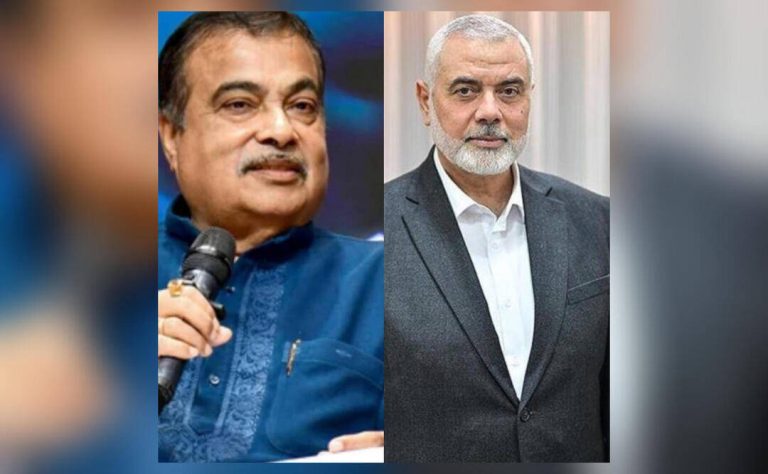
Nitin Gadkari says he met Hamas leader Ismail Haniyeh hours before his murder in Iran
In a shocking revelation, Union Minister Nitin Gadkari has disclosed that he met with Hamas political chief Ismail Haniyeh in Tehran, just hours before the latter’s assassination in 2024. The meeting took place during the inauguration ceremony of Masoud Pezeshkian, where both Gadkari and Haniyeh were in attendance. This unexpected encounter has sent shockwaves across the globe, given the sensitive nature of Haniyeh’s position and the geopolitical tensions surrounding the region.
According to Gadkari, after attending the inauguration ceremony, he returned to his hotel, unaware of the events that would unfold later that day. It was only when the Indian ambassador informed him that they would have to leave immediately due to the assassination of Haniyeh that Gadkari realized the gravity of the situation. This sudden turn of events highlights the complex and often volatile nature of international politics, where alliances and rivalries can shift in an instant.
The assassination of Ismail Haniyeh has significant implications for the Middle East, particularly in the context of the Israeli-Palestinian conflict. As the political chief of Hamas, Haniyeh played a crucial role in shaping the organization’s stance on various issues, including its relations with Israel and other regional players. His murder is likely to escalate tensions in the region, potentially leading to a new wave of violence and instability.
Gadkari’s meeting with Haniyeh, although brief, assumes great significance in this context. As a senior minister in the Indian government, Gadkari’s interactions with foreign leaders are closely watched and analyzed. The fact that he met with Haniyeh, a key figure in the Palestinian Islamist movement, suggests that India may be exploring new avenues of engagement with various stakeholders in the Middle East.
India’s relations with the Middle East are multifaceted and have evolved significantly over the years. The country has traditionally maintained good relations with Iran, while also pursuing strategic partnerships with other regional players, including Israel and the Gulf states. India’s energy security is heavily dependent on the Middle East, and the country has been working to diversify its energy sources and strengthen its ties with the region.
In this backdrop, Gadkari’s meeting with Haniyeh can be seen as part of India’s efforts to engage with different stakeholders in the region. However, the timing of the meeting, just hours before Haniyeh’s assassination, has raised eyebrows and sparked speculation about the circumstances surrounding the event.
The investigation into Haniyeh’s murder is ongoing, with various theories and suspects emerging. The Israeli intelligence agency Mossad has been accused of involvement in the assassination, although Israel has denied any role in the incident. The Iranian Revolutionary Guard Corps (IRGC) has also been implicated in the investigation, with some reports suggesting that the IRGC may have been involved in a plot to eliminate Haniyeh.
As the situation continues to unfold, the international community is watching with bated breath. The assassination of Haniyeh has the potential to destabilize the entire region, and the consequences of such an event could be far-reaching. India, with its significant economic and strategic interests in the Middle East, will be closely monitoring the developments and working to ensure that its relations with the region remain stable and secure.
In conclusion, the revelation by Union Minister Nitin Gadkari that he met with Hamas leader Ismail Haniyeh hours before his assassination in Iran has sent shockwaves across the globe. The incident highlights the complex and often volatile nature of international politics, where alliances and rivalries can shift in an instant. As the investigation into Haniyeh’s murder continues, the international community will be watching with great interest, and India will be working to ensure that its interests in the region remain protected.
About the Author